What's Played When Nobody Pays: Irons
A deep dive inside the bags of tour free agents: the iron brands they choose, how they build combo sets and which models won the money.
Joost Brasser
October 21, 2026 · 9 min read
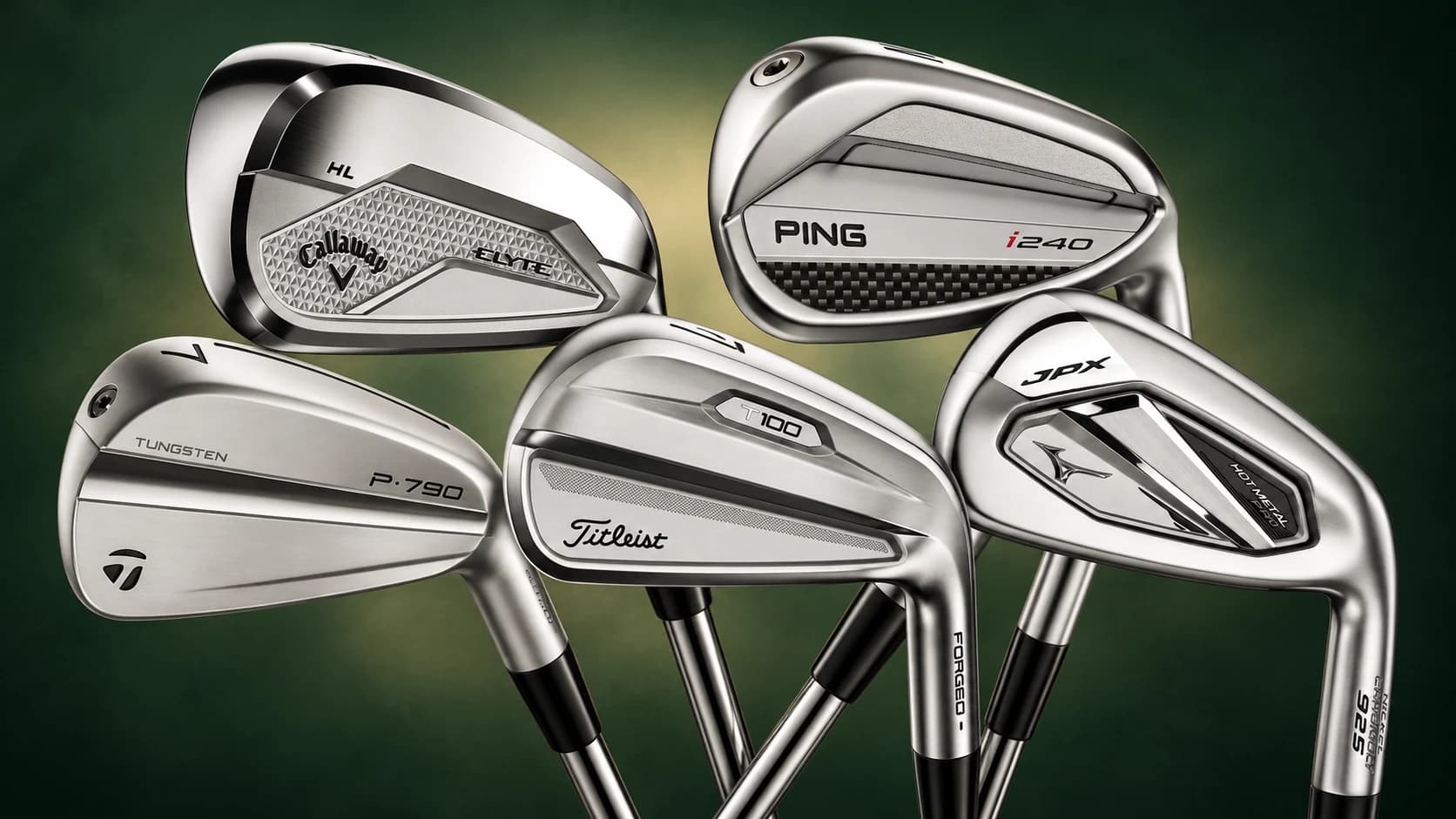
When the PGA Tour's equipment free agents choose a driver, they mostly end up at Titleist or Ping. When they choose irons, all bets are off. Their 7-irons come from 11 different makers, ranging from Titleist and TaylorMade to Bridgestone, McLaren, Miura, Grindworks and Avoda, and three out of four of them don't even play a single model through the set.
Welcome to What's Played When Nobody Pays, a series in which we look at the clubs chosen by the PGA Tour's equipment free agents: players with no club contract who can put anything they like in the bag. Their choices aren't shaped by a staff deal, which makes them about the most honest equipment verdict you'll find on tour.
In this edition we dive into the irons of the 23 free agents on the PGA Tour in 2026: which brands they choose, what kind of heads they trust, how they build the long end of the bag, which irons won the money and why a surprising number end up with a boutique brand. Where it helps, we compare them with the 91 players who have a full or partial equipment deal.
No brand rules the free agent iron market
Among free agents, the biggest single "brand" for irons isn't a brand at all: it's the group of small makers and prototypes, with six players. Titleist and TaylorMade follow with five each, then Srixon and Ping with three. That's a very different picture from the contracted players, where Titleist alone accounts for 31 percent and not a single player uses a boutique set.
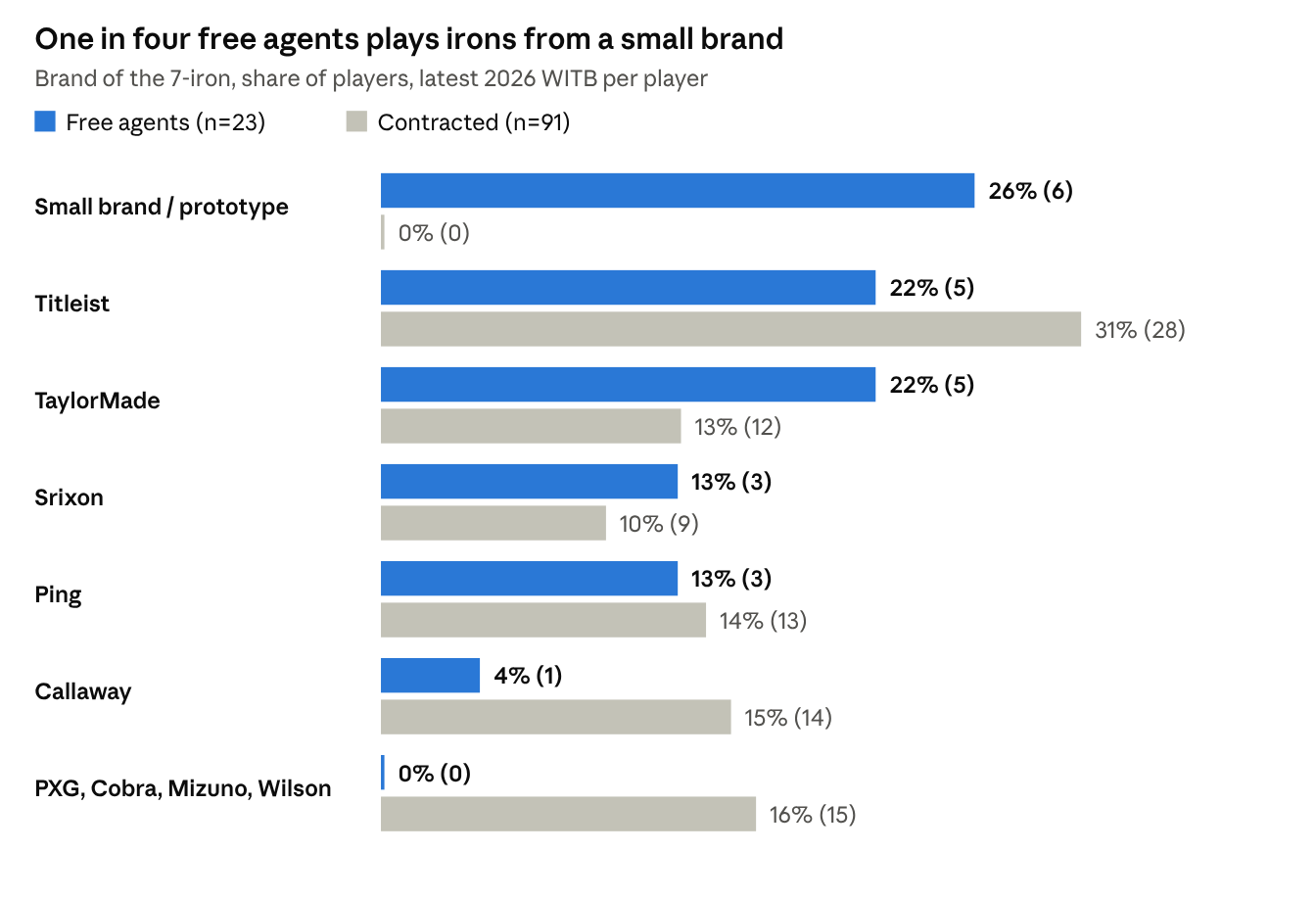
Source: latest 2026 WITB per player (GolfWRX, Golf Monthly), contract status our own research. Small brand or prototype: Bridgestone, McLaren, Miura, Grindworks, Avoda and DeChambeau prototype.
Two things stand out. TaylorMade does relatively well among free agents, with 22 percent of 7-irons against 13 percent among contracted players, and every one of those five plays a P7 model: P7TW, P7MB, P7MC or P7CB. Callaway, on the other hand, practically disappears: 15 percent of contracted players use Callaway irons, but Adam Scott's Apex MB is the only Callaway 7-iron in a free agent's bag.
PXG, Cobra, Mizuno and Wilson, which together supply 16 percent of contracted players, don't appear among the free agents at all. That's not necessarily a verdict on the quality of their irons, but it does show that these brands owe their presence on tour almost entirely to staff deals.
Blades are back, but the cavity back still wins
If you assumed every tour player hits butter-knife blades, the numbers will surprise you a little. The most common 7-iron among free agents is a compact players cavity back, such as the Titleist T100, Ping S55 or TaylorMade P7CB, while the pure blades come in second.
| Type of 7-iron | Free agents | Examples |
|---|---|---|
| Players cavity back | 11 | Titleist T100 (Clark, A. Fitzpatrick), Ping S55 (M. Fitzpatrick, Jaeger), Titleist 718 AP2 (Cantlay) |
| Blade or muscle back | 7 | Bridgestone 220 MB (Gotterup), TaylorMade P7TW (Rai), Callaway Apex MB (Scott), Miura MB-101 (Herbert) |
| Muscle cavity | 2 | TaylorMade P7MC (Chacarra, Higgs) |
| Custom prototype | 3 | Avoda (Day), Grindworks (Reed), DeChambeau |
What's almost universal is the combo set. 17 of the 23 free agents, or 74 percent, play two or more different models in their iron set, typically a more forgiving long iron on top of a blade or cavity back in the scoring clubs. Only six play one model from top to bottom: Rai, Alex Fitzpatrick, McNealy, Jaeger, Day and DeChambeau.
None of the 23 play a true game-improvement iron, which won't come as a shock. But the fact that the more forgiving cavity back outnumbers the blade, even at this level, is a useful reminder that a little help on mis-hits isn't something even the best players turn down.
The top of the bag is a puzzle everyone solves differently
The long end of the iron set is where free agents tinker most. Ten of them start their irons at the 4-iron, but the range runs from Eugenio Chacarra's TaylorMade UDI 1-iron to five players who don't carry anything longer than a 5-iron and fill the gap with fairway woods or a hybrid instead.
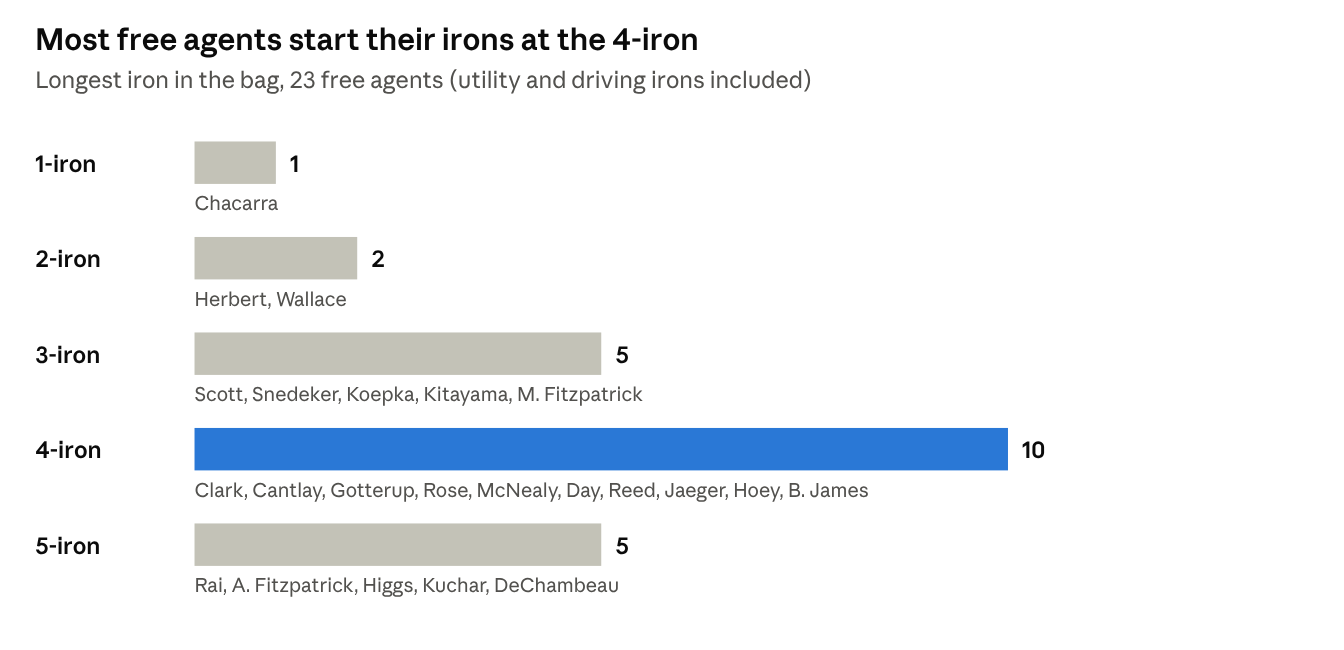
Source: latest 2026 WITB per player (GolfWRX, Golf Monthly). Hoey's longest club is a Srixon ZXiU utility, counted at the 4-iron slot.
The clubs they use up there are often from a different brand than the rest of the set. A few long irons pop up again and again in free agent bags:
- Srixon ZXi5: the long iron of choice for Cantlay, Higgs and Herbert, none of whom play Srixon in their scoring irons.
- Titleist T250: a players distance iron at the top of the set for Adam Scott, Kurt Kitayama and Matt Wallace.
- Ping iDi: Ping's driving iron, used by Brandt Snedeker and Matt Wallace.
- The odd ones out: Koepka still has a Nike Vapor Pro 3-iron in the bag, a full decade after Nike stopped making clubs, and Chacarra goes all the way up to a 1-iron.
The logic is simple enough. A long iron is the hardest iron to hit, and it's the club where forgiveness and launch matter most, so even players who love the feel of a blade are happy to swap in something chunkier at the top. Combined with the rise of the 7-wood, it means the classic blade 3-iron is becoming a rare sight.
Where the money went
To see which irons actually paid off, we matched each free agent's 7-iron to the event he was playing and credited that week's prize money to that model. The result is a familiar pattern: a handful of players in form carry most of the weight.
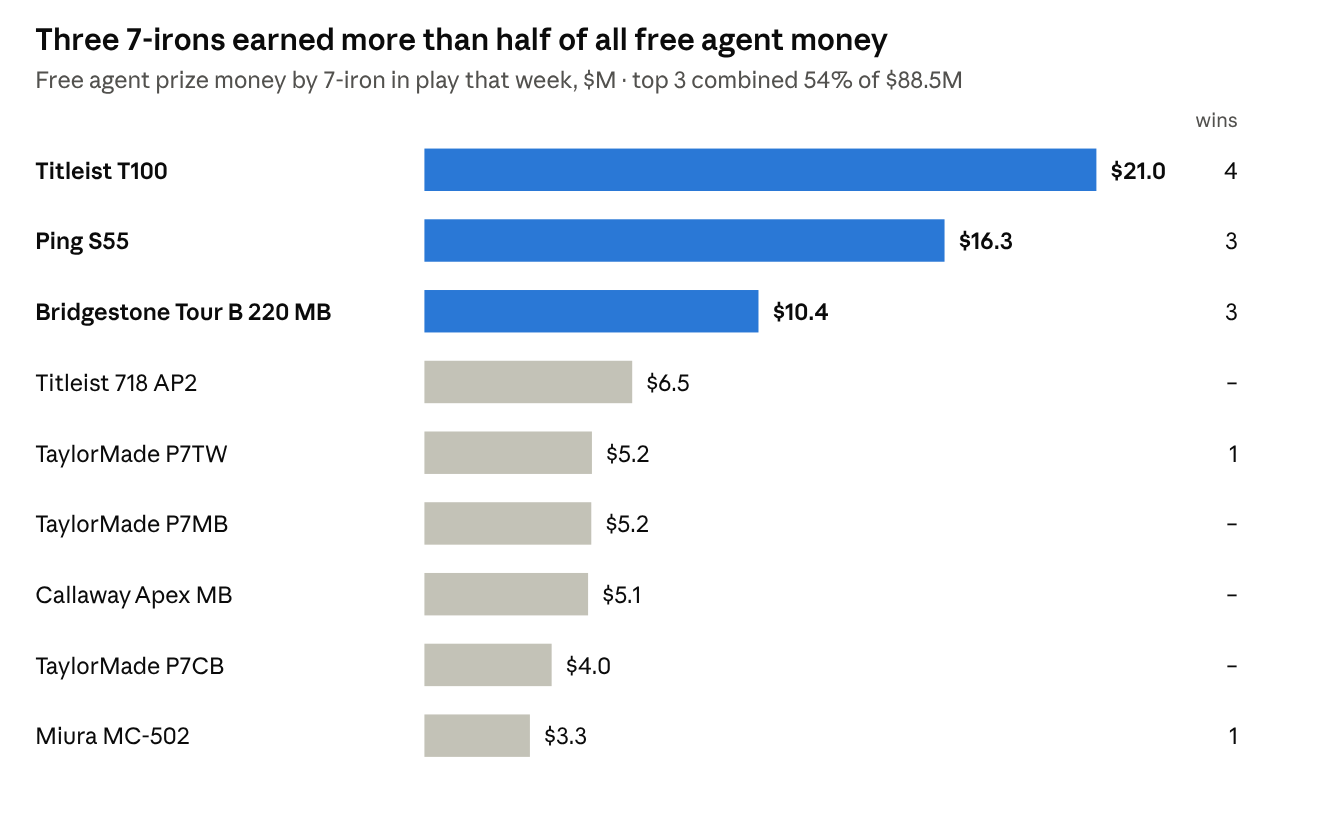
Source: results of 33 major, signature, playoff and full-field PGA Tour events in 2026 (The Golf News Net, pgatour.com), matched to the bag in play that week. Free agents only, made cuts only, Zurich Classic counted per player.
The Titleist T100 tops the list thanks to Wyndham Clark, who won the Byron Nelson, the U.S. Open and the BMW Championship with T100s from the 6-iron down, plus Alex Fitzpatrick's share of the Zurich. The Ping S55 is Matt Fitzpatrick's season, and the Bridgestone 220 MB is all Chris Gotterup. Notice that two of the top three are cavity backs, not blades, which fits neatly with what we saw earlier.
Further down are a couple of irons that tell their own story. Patrick Cantlay earned $6.5 million with Titleist 718 AP2s, a model from 2017, and Justin Rose won the Farmers with Miura MC-502s before switching to McLaren in the spring.
The boutique six: free choice or quiet deal?
Six free agents play irons from a small brand or a custom prototype, which is easily the most eye-catching finding in this report. But "free agent" means no deal with a major club company, not necessarily no deal at all, so we looked into why each of the six ended up where they are.
| Player | Irons | Why | Paid for it? |
|---|---|---|---|
| Chris Gotterup | Bridgestone Tour B 220 MB | Bridgestone staffer since 2023, contract extended in 2025. Free to choose his driver, woods and putter | Yes |
| Justin Rose | McLaren prototypes (Miura when he won the Farmers) | Became McLaren Golf's first tour staffer and an investor in the company in late April | Yes, and he owns a piece of it |
| Patrick Reed | Grindworks PR-101A and PR-202 | Long-running partnership with the Japanese brand, which builds models to his requests | Partnership, terms unknown |
| Bryson DeChambeau | Own prototypes, Avoda irons earlier in the year | Builds and tinkers himself after splitting with LA Golf in February | No |
| Jason Day | Avoda prototypes | Built to his exact specs, from offset to sole lean | No |
| Lucas Herbert | Miura MB-101 and TC-202 in a mixed set | Equipment free agent, no deal with Miura that we could find | Not as far as we know |
So half of the boutique six have some kind of commercial tie to their iron maker. Gotterup's Bridgestone blades are part of a contract, Rose became a McLaren investor, and Reed's Grindworks relationship goes back years. That leaves Day, Herbert and DeChambeau as the genuinely free choices, and even Bryson is a special case since he's effectively his own equipment company.
"I don't get paid by Avoda. I use them freely."
Jason Day, to GolfWRX
What ties all six together is the desire for something built to measure. Day talks about matching the lean of the sole to his forward press, Reed asked Grindworks for a 3-iron that wouldn't turn over on knockdowns, and DeChambeau prints his own heads. That's a level of customization that's simply harder to get from a set off the rack, even a tour-issue one, and it's the clearest explanation for why small makers do so well in this corner of the bag.
What it means for your next set
Tour players strike the ball far more consistently than the rest of us, so their exact heads aren't a shopping list. The way they put a set together, though, translates surprisingly well to any handicap.
- Build a combo set. Three out of four free agents mix models, and almost always in the same direction: more help at the long end, more control at the short end. If you love the look of a blade but can't hit a blade 4-iron, you're in very good company.
- Don't be afraid of a cavity back. The most popular 7-iron among the best players with a free choice is a compact cavity back, not a blade. A little forgiveness isn't a sign of weakness.
- Rethink your longest iron. Ten free agents start at the 4-iron and five at the 5-iron, filling the gap with a utility iron, a 7-wood or a hybrid. Most amateurs will benefit from going even further in that direction.
- Look beyond the big brands. The boutique makers do well here because they build to measure, so if you're the kind of golfer who cares about sole grinds and offset, a custom fitting with a smaller maker could be worth the trip.
- New isn't required. Cantlay earned $6.5 million with irons from 2017. A well-fitted older set will beat an ill-fitting new one every time.
Keep reading

Viktor Hovland: These Are the Clubs the Norwegian Uses to Storm the World's Elite
From a trusty set of Ping i210 irons to a prototype putter, Hovland's bag mixes proven favorites with modern firepower. A look at his full setup, with distances.
By Jan Kuijpers · July 12, 2026
Joost Luiten chases $680,000 top prize in India
Joost Luiten starts the final round of the DP World India Championship in pursuit. This is the prize money at stake in New Delhi.
By Jan Kuijpers · October 18, 2026
Rory McIlroy trades slim fit for wide trousers in India
Rory McIlroy has given his familiar tapered golf look a roomier update at the DP World India Championship, inspired by Tommy Fleetwood and the heat in Delhi.
By Jan Kuijpers · October 16, 2026